

No one was surprised when the Federal Reserve raised the Fed Funds rate by a quarter point on September 16. While it was the Fed's first hike since 2023, it was fully in line with market expectations.
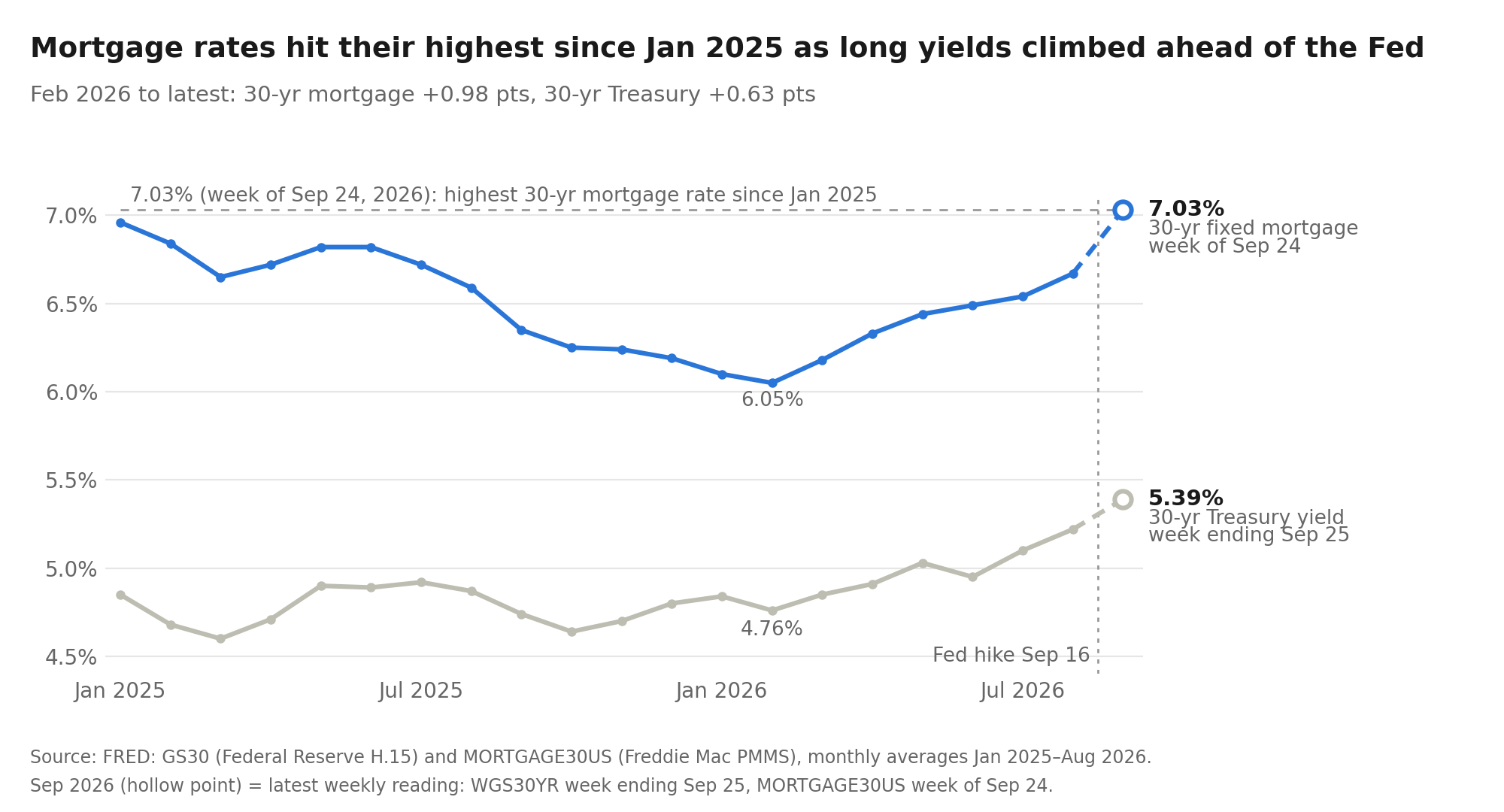
The bond market had already done the Fed's work. Long-term yields climbed all summer, and mortgage rates followed. Last week the average 30-year fixed mortgage rate crossed 7% for the first time since January 2025.
Consumers felt it in August, before the Fed ever moved. Alpharank's first-party data show demand for rate-sensitive lending pulling back sharply, with one clear exception: vehicle loans.
In a stark reversal from July, August's pattern is clearly interest rate-driven: the more a product's payment depends on the rate, the larger the drop in demand.
Median approved vehicle loan applications grew 6% in August versus July, and deposits edged up 2%. Everything else went backward: credit cards slipped 1%, personal loans fell 10%, and home lending dropped a steep 28%.
🚗 Vehicle Loans: +6%
💵 Deposits: +2%
💳 Credit Cards: -1%
💰 Personal Loans: -10%
🏡 Home Lending: -28%
It's the Monthly Payment
American consumers don't shop for a loan amount. They shop for a monthly payment they can afford, and therefore the rate decides how much house or car that payment buys.
On a 30-year fixed mortgage, a 1 percentage point increase in rates cuts purchasing power by roughly 10%. A buyer whose budget covers a $400,000 loan at 6% can borrow only about $360,000 for the same payment at 7%.
That math explains August. Home lending, the product with the longest term and the biggest balance, took the largest hit. Personal loans followed, as borrowers who stretched their budgets earlier this summer pulled back.
Vehicle Loans Resist
Vehicle lending was the only loan category to grow in August, extending a run of gains we've tracked since May (+4% in May, flat in June, +11% in July).
For most American consumers, a car is a necessity, not a luxury. They depend on it to get to work and school and to buy essentials, so when a car needs replacing, the purchase happens regardless of the rate. A shorter loan term also blunts the rate's effect: on a 60-month auto loan, a 1-point increase cuts purchasing power by only about 2%.
The Next 12 Months: Higher for Longer
Don't expect relief soon. The Fed's September projections indicate a likely quarter-point hike before year-end, ending 2026 at 4.1%, with no change in 2027 and cuts only coming in 2028.
Markets are even more bearish, with yields pricing a better-than-75% chance of another hike in October, and futures price hikes continuing into 2027. Meanwhile, the 30-year Treasury yield has pushed past 5.6%, a level last seen in 2002.
What This Means for Your Financial Institution
When every point of rate costs your members a tenth of their buying power, there is less business to win. The institutions that grow in this market will be the ones that convert the demand that remains, especially in auto lending and deposits.
To win market share in a high-rate environment, you need to get the most from every dollar you spend and prove what is working.
Alpharank helps financial institutions navigate to optimize growth investments, typically seeing a +50% increase in funded accounts in the first six months. Reach out to our team today to see how we can help you do just this.
About Alpharank and our data:
200+ banks and credit unions trust Alpharank to optimize production from their websites and online applications, resulting in dollars booked to the balance sheet. Without storing personal information, our data models and benchmarks are trained on a unique dataset of over 8 billion full-funnel events with known balance sheet outcomes.
Most financial institutions buy clicks from Google, Meta, etc., and just hope for funded applications. Alpharank measures the quality of your clicks so you only buy the good stuff. Stop their algorithm from draining your budget while sending you lookers, not bookers. Pay for performance only and get 50% more for your marketing dollar.
🔎 Learn more about how you win with better click intent, journey efficiency and effectiveness, prospect quality, and campaign optimization. Request a free competitive assessment today.
Sources
- Board of Governors of the Federal Reserve System, Market Yield on U.S. Treasury Securities at 30-Year Constant Maturity (GS30), retrieved from FRED, Federal Reserve Bank of St. Louis
- Freddie Mac, 30-Year Fixed Rate Mortgage Average in the United States (MORTGAGE30US), retrieved from FRED, Federal Reserve Bank of St. Louis
- Alpharank first-party data: median approved applications per FI, August 2026 vs. July 2026